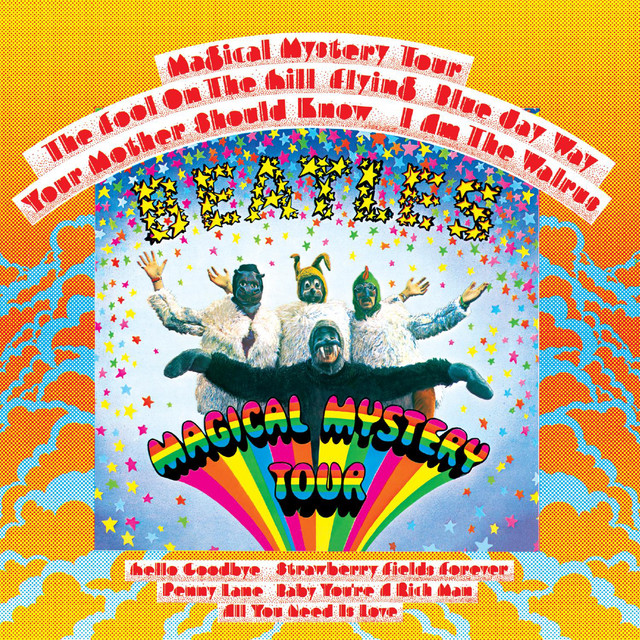
Introduction to a Surreal Journey
The Beatles' "Magical Mystery Tour," originally released as a double EP in the UK and an LP in the US in 1967, stands as a testament to the band's fearless experimentation. With its vibrant colors and whimsical narratives, the project sought to merge music with film in ways that were revolutionary for its time, setting the stage for a new era in both mediums.
A Film That Defied Convention
Inspired by the avant-garde and the psychedelic movement, the film that accompanied the album was both a celebration and a critique of the counterculture of the late 1960s. The Beatles, with their penchant for the surreal, crafted a narrative that was less about plot and more about experience — an odyssey through a kaleidoscope of images and sounds.
"Roll up, roll up for the Magical Mystery Tour"
These opening lines invite listeners into a world where the ordinary is transformed into the extraordinary. The song's playful tone sets the groundwork for the film's journey, suggesting a departure from reality that mirrors the experimental cinema of the time.
Influences from Cinema
Director and collaborator Paul McCartney drew inspiration from various cinematic styles, particularly the works of French New Wave filmmakers like Jean-Luc Godard. They embraced spontaneity and a break from traditional storytelling, which is evident in the film's non-linear structure and surreal visuals. The Beatles' engagement with visual arts was not merely an aesthetic choice but a philosophical stance against the rigid conventions of pop culture.
The film was initially met with mixed reviews but has since gained a cult following, regarded as a pioneering work of experimental film.
Soundscapes and Surrealism
Musically, "Magical Mystery Tour" fuses elements of rock, pop, and psychedelia. Tracks like "The Fool on the Hill" and "I Am the Walrus" showcase a blend of orchestration and unconventional song structures that echo the film's surreal themes. The Beatles pushed boundaries, using innovative studio techniques that were ahead of their time.
"Sitting on a cornflake, waiting for the sun"
This lyric from "I Am the Walrus" exemplifies the absurdity and whimsy that permeates both the song and the film. It captures the essence of a dream-like state where logic takes a back seat to imagination, reinforcing the album's cinematic aspirations.
The Cultural Impact
The remastered version released in 2009 brought renewed attention to the project, showcasing the rich audio landscape that The Beatles crafted. The vibrant colors of the film were matched with a sonic clarity that allowed new generations to experience the magic as if for the first time. The remastering process highlighted the innovative production techniques employed by George Martin, which remain influential in modern music.
In 1988, the Beatles' core catalog was harmonized, leading to a reevaluation of "Magical Mystery Tour" as a key component of their legacy.
Legacy of Surrealism
Today, "Magical Mystery Tour" is celebrated not just as an album, but as a cultural artifact that encapsulated the spirit of the 1960s. Its fusion of music and film continues to inspire artists across genres, demonstrating that the boundaries of creativity can be pushed and redefined. The Beatles showed us that art need not conform to reality — it can be a magical mystery all its own.